

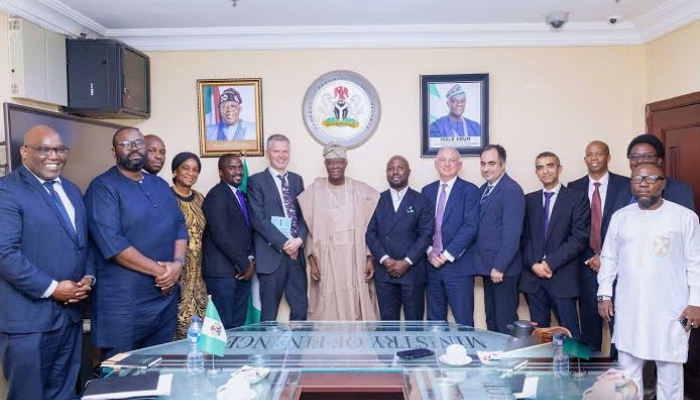
The Federal Government has announced the establishment of a Nigeria Deal Room, a structured investment platform designed to close the persistent gap between investment interest and actual capital deployment.
Finance Minister Taiwo Oyedele unveiled the initiative at the Invest in Lagos 3.0 summit on Sunday, describing it as a deliberate institutional response to a pattern that has long frustrated Nigeria’s investment environment: opportunities are identified, interest is expressed, commitments are signed — and then the capital does not arrive.
Read also: Nigeria’s capital inflows hit $10.37bn in Q1 2026, FDI decline signals investment gap
The problem it is designed to solve
Oyedele was direct about the diagnosis. Too often, he said, brilliant opportunities are known but insufficiently prepared. Investors are highly interested but cannot navigate the entry points. Projects exist, but they are not bankable or investment-ready. The Deal Room is designed to address all three of those failures simultaneously by improving project preparation, facilitating regulatory approvals, and enhancing coordination between project sponsors, investors, and government agencies.
The platform will function as a structured marketplace where investors, project sponsors, development finance institutions, and policymakers can engage around commercially viable projects across infrastructure, housing, energy, manufacturing, agriculture, and technology. A central investor desk within the Ministry of Finance will serve as a single interface for policy communication, disclosure, and engagement — replacing the fragmented entry points that have historically made Nigeria difficult for foreign investors to navigate efficiently.
Nigeria has been generating investment pledges at summits for years. The Deal Room is an institutional admission that pledges without preparation are not investments — and a structural attempt to change that.
Read also: German state explores expanded trade, investment partnership with Nigeria
The macroeconomic backdrop
Oyedele used the announcement to highlight Nigeria’s improving economic fundamentals, noting that the country recorded real GDP growth of 3.89 per cent in Q1 2026 and achieved 11.2 per cent growth in US dollar terms in 2025. He described Nigeria as on track to deliver another year of double-digit GDP growth in dollar terms, positioning it among the top contributors to global economic growth in 2026.
He also stressed that Nigeria’s growth story is increasingly being driven at the state level — in Lagos, Kano, Enugu, Uyo, Abeokuta, Ilorin, Kaduna, Lafia, Owerri, and Umuahia — and that subnational governments converting potential into projects, investments, and jobs are where the most visible economic outcomes are emerging.
Read also: Nigerian stock market movement reflects cautious investor sentiment
What it means for SMEs and the business community
For Nigerian businesses and SMEs, the Deal Room’s value lies in what structured investment ultimately enables: infrastructure that reduces operating costs, energy projects that improve power supply, agricultural value chains that strengthen supply, and manufacturing capacity that creates demand for local inputs and services.
The Federal Ministry of Industry, Trade and Investment confirmed in its 2026 outlook that over $200 million was disbursed to MSMEs and exporters in 2025 through the Bank of Industry and the Nigerian Export-Import Bank, reaching more than 115,000 small businesses through grants, loans, and trade finance. The Deal Room is designed to operate at a larger scale, channelling institutional and private capital into projects that create the conditions under which more of those businesses can grow.
A platform that makes Nigeria easier to invest in is ultimately a platform that makes Nigeria easier to build a business in. The gap between the two has always been shorter than it appears.