

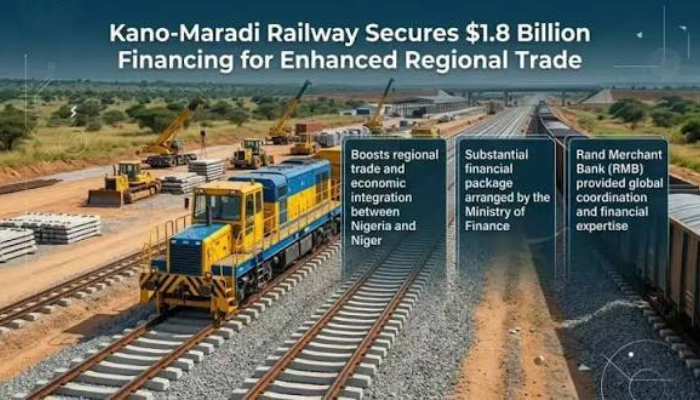
Rand Merchant Bank has finalised a $1.8 billion financing package for the development, construction, and commissioning of the 374-kilometre Kano-Maradi railway project, linking Kano in northern Nigeria to Maradi in the Niger Republic. Acting as Global Coordinator and Initial Mandated Lead Arranger, RMB worked alongside Nigeria’s Ministry of Finance to mobilise funding from multiple sources including development finance institutions, export credit agencies, and local currency financiers — completing one of the most complex cross-border infrastructure financing transactions in the region in recent years.
Read also: SolarAfrica secures R1.8 bn investment for SunCentral project
What the project involves
The Kano-Maradi railway will run from Kano through Danbatta, Kazaure, Daura, Mashi, and Katsina before crossing into Niger Republic and terminating at Maradi. Portuguese construction and engineering firm Mota-Engil Africa is the EPC contractor responsible for delivering the project on the ground, with RMB having supported the firm across multiple African projects previously.
Chidi Iwuchukwu, Executive Director and Head of Investment Banking at RMB Nigeria, described the deal as a pivotal transaction that connects regional entities and supports trade and development across the corridor. He noted that the RMB team had to demonstrate considerable skill in structuring cross-border financing for a sovereign borrower under an EPC plus financing arrangement — a structure that required coordinating the requirements of international and domestic lenders simultaneously.
Enyinna Anumudu, Senior Dealmaker and Head of Infrastructure Finance at RMB Nigeria, acknowledged the complexity of the execution, noting that the number of institutions involved demanded substantial resources to coordinate due diligence, KYC requirements, and onboarding across multiple financing parties before achieving financial close.
Closing a $1.8 billion cross-border infrastructure deal is not a straightforward transaction under any circumstances. That it was achieved across sovereign borders, with multiple DFIs and local currency financiers involved, reflects both the strategic importance the market attaches to this corridor and RMB’s ability to hold a complex deal together over a three-year execution period.
Read also: Take advantage of local infrastructure and business communities for growth
What it means for northern Nigeria and SMEs
The Kano-Maradi railway addresses a long-standing infrastructure gap in Nigeria’s north, a region where road-dependent logistics have driven up the cost of moving goods and limited the competitiveness of businesses operating along the Nigeria-Niger trade corridor. Kano is Nigeria’s second-largest commercial city and a hub for agriculture, manufacturing, and textile trade. Maradi is one of Niger Republic’s most economically active cities, with strong cross-border commerce in food commodities, livestock, and manufactured goods.
When rail reduces the cost and time of moving goods between two of West Africa’s busiest inland commercial centres, the businesses that benefit most are not multinationals with their own logistics infrastructure — they are the traders, manufacturers, and processors who have been absorbing the full cost of inadequate transport for decades.
For SMEs in logistics, agriculture, and trade across Kano, Katsina, and the broader north, a functional railway corridor creates new commercial possibilities — faster market access, lower freight costs, and a more reliable supply chain to and from Niger Republic. The project also aligns with Nigeria’s commitment to reduce carbon emissions by 94 per cent by 2050, positioning rail as both an economic and sustainability infrastructure investment.