

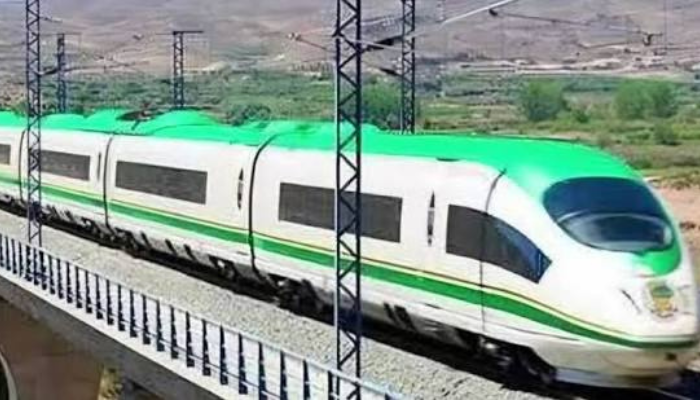
The Federal Government has announced plans to construct a 360-kilometre-per-hour high-speed railway connecting Lagos to Kano, Nigeria’s two largest commercial cities, in what would represent the most ambitious and commercially consequential transport infrastructure investment the country has approved in decades.
The announcement, made this week, forms part of a broader rail network expansion plan that also covers high-speed routes from Lagos to Abuja and Abuja to Kano, effectively linking Nigeria’s three economic anchors through an integrated rapid transit system.
Read also: SEC warns Nigerian businesses, weak ESG disclosures could cost global investment
What the project involves
The proposed high-speed rail would travel at speeds of 360 kilometres per hour — comparable to China’s high-speed rail network and significantly faster than any existing rail service in sub-Saharan Africa. At that speed, a journey from Lagos to Kano that currently takes more than 12 hours by road and is regularly disrupted by security concerns and road conditions would be completed in approximately two to three hours.
The government has not yet disclosed total project cost, implementation timeline, or financing structure — details that will determine whether this announcement becomes a construction project or joins the long list of Nigerian infrastructure commitments that were never executed. However, the simultaneous mention of the Lagos-Abuja and Abuja-Kano corridors suggests a comprehensive national rail framework rather than a single corridor investment.
The idea of a high-speed rail linking Lagos and Kano is not new. What matters is the financing structure, the implementation partner, the land acquisition plan, and the political will to see it through. Announcements in Nigeria’s infrastructure sector carry credibility only when contracts are signed and construction begins.
Read also: Tinubu approves $50bn deep offshore investment framework to revive stalled oil projects
What it means for businesses
If executed at even a fraction of its stated ambition, a high-speed rail connecting Lagos, Abuja, and Kano would transform the commercial geography of Nigeria. The cost and time of moving goods, people, and services between the country’s three largest economic centres would decline dramatically. Supply chains that currently require overnight road journeys with associated security risks, delays, and fuel costs would be replaced by reliable, high-frequency rail connections.
For Nigerian SMEs in logistics, trade, manufacturing, and professional services, the reduction in distance and time between major markets could be the single most transformative infrastructure development in the country’s recent history — enabling businesses to serve national markets from a single location, reducing the need for costly local inventories and multiple regional offices, and making Nigeria’s internal market function more like a single integrated economy.
The Kano-Maradi railway connecting Nigeria to Niger Republic was a $1.8 billion deal. The Lagos-Kano high-speed rail would be a multiple of that cost. The question is not whether Nigeria can imagine infrastructure of this scale — it clearly can. The question is whether the institutional capacity, the financing, and the political continuity exist to build it.