

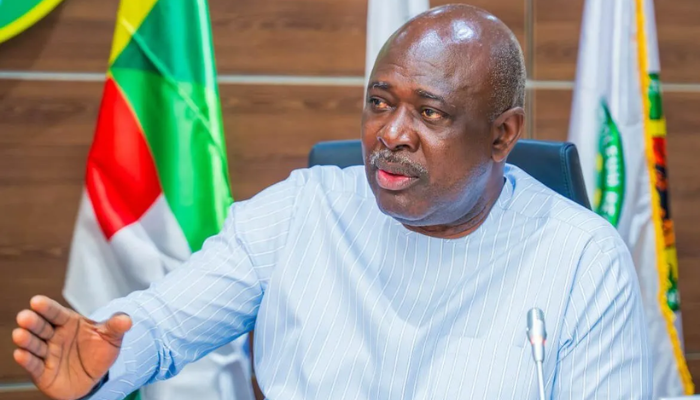
Nigeria and other African countries spend more than $120 billion every year importing refined fuel and other hydrocarbon-related services, despite having some of the world’s largest oil and gas reserves, Nigeria’s Minister of Petroleum Resources (Oil), Heineken Lokpobiri, has said.
He spoke on Tuesday at the Nigerian International Energy Summit (NIES) in Abuja, where energy leaders and policymakers gathered to discuss Africa’s energy future.
Read also: UAE’s largest bank bets on Nigeria for Africa growth
$120bn spent on imports
Lokpobiri said Africa’s continued reliance on imported refined petroleum products represents a major loss of economic opportunity for the continent.
“Africa currently spends over $120 billion annually on hydrocarbons alone, a staggering outflow of capital,” he said. “This level of expenditure, primarily on the importation of refined petroleum products and other hydrocarbon-related services, represents not just a financial cost, but a lost opportunity for economic transformation.”
He explained that retaining even a portion of this spending within Africa through local refining, infrastructure development and industrial participation could significantly change economic outcomes across the continent.
Read also: PayPal returns to Nigeria with $100m fund to tap booming fintech sector
Call to support African Energy Bank
The minister urged African countries to support the African Energy Bank (AEB), which is expected to be headquartered in Nigeria. He said the bank would play a key role in mobilising resources to address Africa’s energy challenges.
“That is why we should support the African Energy Bank (AEB) with its headquarters in Nigeria,” Lokpobiri said. “If we do not mobilize the appropriate resources to solve our energy problems in Africa our misery will increase as our population grows, the responsibility is ours and ours alone.”
He added that Nigeria had already fulfilled its obligations as host country and called on promoters to move the process forward.
“As host country we have fulfilled our obligations, the ball is in the court of the promoters to set the ball rolling,” he said.
Read also: Tanzania bets on local drug factories to cut $1bn import bill
Energy mix, not abandonment of oil and gas
Lokpobiri rejected claims that the world is moving away from oil and gas, stating that global discussions have shifted from energy transition to energy mix.
“No country in the world is abandoning oil and gas, and you can be rest assured that Nigeria will not either,” he said.
Citing reports such as the International Energy Agency (IEA) World Outlook 2025 and the OPEC World Outlook 2025, he noted that fossil fuels will remain dominant in the foreseeable future.
He stressed the need for governments to address the energy trilemma of availability, accessibility and affordability.
Read also: Fela Kuti becomes first African to receive Grammy lifetime achievement award
Africa losing value from exports
Also speaking at the summit, Farid Ghezali, Secretary General of the African Petroleum Producers’ Organization (APPO), said Africa’s challenge is not resource availability but value creation.
He said Africa exports about 70 percent of its crude oil and 45 percent of its natural gas, resulting in an estimated $15 billion loss annually.
“This is an added value that could be generated locally, especially in the midstream and downstream segments,” he said.
Read also: Rewane projects Dangote Refinery listing to lift NGX capitalisation above N200trn
Financing gap slows projects
Ghezali said high financing costs remain a major barrier to energy development in Africa. He noted that more than 150 key projects, including refineries, pipelines and gas infrastructure such as the AKK pipeline, are stalled.
He said financing costs in Africa range between 15 and 20 percent, compared to 4 to 6 percent in Asia.
“This disparity is unacceptable and slows down our progress,” he said.
Read also: Non-oil export revenues set record in 2025, driving diversification efforts
African Energy Bank to launch in 2026
To address these challenges, Ghezali said APPO is advancing the African Energy Bank, which is expected to launch in the first half of 2026.
“The bank is much more than just a financial institution,” he said. “It is a pan-African platform for the exchange of equipment, energy services and, above all, a catalyst for innovative financing to support structuring African energy projects.”
He added: “Because I think it’s time to produce what we are consuming and to consume what we are producing.”
The bank aims to unlock $200 billion for Africa’s midstream and downstream energy projects by 2030.