


…Warns naira could weaken to N1,590/$ by end of 2026
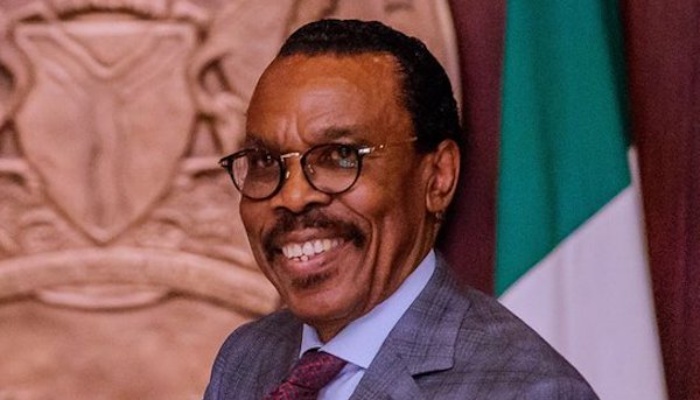
Bismarck Rewane, chief executive officer of Financial Derivatives Company, has said the expected listing of the Dangote Refinery on the Nigerian Exchange (NGX) in 2026 could push Nigeria’s stock market capitalisation above N200 trillion, while projecting a gradual weakening of the naira to about N1,590 per dollar by the end of 2026.
Rewane made the remarks at the 2026 Economic Outlook Summit of RCCG Christ Church, held in Lagos at the weekend, where he shared his outlook on the economy, the foreign exchange market and capital markets.
Read also: Non-oil export revenues set record in 2025, driving diversification efforts
Dangote Refinery listing and capital market impact
According to Rewane, the anticipated public listing of the Dangote Refinery would be a major development for Nigeria’s capital market because of the size and valuation of the asset.
“We expect the Dangote Refinery to list. If it is listed at today’s valuations, we think it will increase stock market capitalisation from about N105 trillion to over N200 trillion,” he said.
He explained that such a listing would expand the depth of the market and increase liquidity, while also changing how global investors view Nigeria’s equities market.
Rewane added that the move could position the Nigerian Exchange as one of the larger emerging market exchanges by size, creating more opportunities for institutional and retail investors.
Read also: Business output expands strongly in 2025, signalling robust momentum
Naira outlook and dollar expectations
On the foreign exchange market, Rewane projected that the naira would weaken to around N1,590 per dollar by the end of 2026, despite expecting the US dollar to lose strength against other major currencies.
“The US dollar is going to weaken because of various forces. There will be a Federal Reserve meeting this month in the US, where interest rates and other policy signals will be clarified. So, we expect a weaker US dollar this year relative to other currencies,” he said.
He noted that despite this medium-term outlook, the naira has remained largely stable through 2025.
“The exchange rate has been largely stable through 2025, but the widening gap between the official rates and the market suggests renewed pressure in the FX market,” Rewane said, pointing to a difference of about N71 between the official and parallel market rates.
Reiterating his forecast, he said: “The naira is expected to weaken to roughly N1,590 per dollar by the end of 2026.”
Read also: MTN Foundation expands ICT training to empower Nigerian entrepreneurs
Recent FX market performance
Meanwhile, the naira closed the five-day trading week mostly flat across the foreign exchange market as Nigeria’s external reserves rose above $46 billion.
Figures released by the Central Bank of Nigeria showed that the naira appreciated slightly to N1,421.62 per dollar on Friday, a 45 kobo gain from N1,422.07 recorded at the Nigerian Foreign Exchange Market the previous day.
The modest movement reflects ongoing efforts to stabilise the market amid changing global and domestic conditions.
Read also: Tax reforms take effect, impacting MSMEs compliance and growth
Government reforms and 2026 expectations
Also speaking at the summit, John Enoh, minister of State for Industry, Trade and Investment, said the Federal Government had laid the groundwork for competitiveness and sustainable economic growth through ongoing reforms.
“The government has laid the foundation for competitiveness and sustainable growth. At the heart of these reforms is the belief that Nigeria will grow sustainably when policy rewards production over consumption and long-term value creation over the short term,” Enoh said.
He noted that the administration inherited structural challenges such as heavy import dependence, low investment relative to gross domestic product and weak infrastructure.
According to him, current reforms are focused on improving predictability, stability and fairness in the policy environment.
“Our reforms are not just chasing perfection but building predictability, stability and fairness,” he said.
Enoh described 2026 as a year when the effects of these reforms should become clearer to businesses and households.
“2026 must be a year of impact and outcomes, more jobs, stronger industries, increased trade, deeper investments and renewed hope, in line with the mantra of this administration,” he said.
Private sector and employment realities
Muda Yusuf, chief executive officer of the Centre for the Promotion of Private Enterprise, also addressed the summit, highlighting both opportunities and pressures within Nigeria’s business environment.
Yusuf encouraged Nigerians to consider moving from paid employment to self-employment and entrepreneurship, noting that some salary levels no longer reflect current economic conditions.
His comments reflected growing concerns about income, costs and the need for adaptability as the economy adjusts to reforms and market changes.