

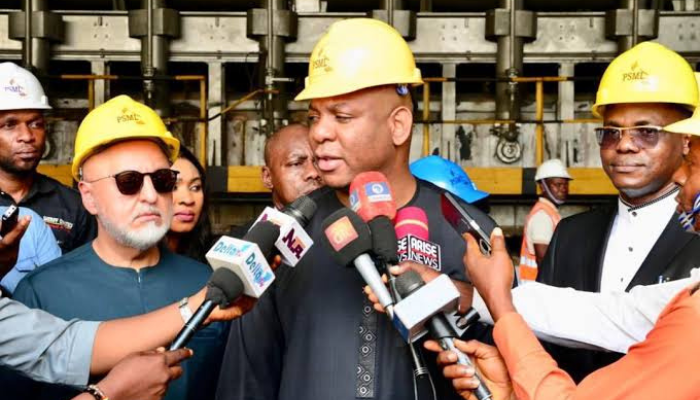
The Federal Government has signed a Sub-lease and Operations Agreement with the National Iron Ore Mining Company and Premium Steel and Mines Limited, committing more than $1.3 billion to rehabilitate and modernise the long-dormant Delta Steel Company in Ovwian-Aladja, Delta State.
The agreement, executed on 20 August 2026, is the most concrete step in decades toward restarting what was once Nigeria’s most ambitious industrial project — commissioned in 1982 with an installed capacity of one million metric tonnes of liquid steel annually before slipping into prolonged inactivity.
Read also: Manufacturing credit falls N1.92 tn as banks turn away from Nigeria’s productive sector
What the agreement commits
Premium Steel and Mines Limited has committed to investing the $1.3 billion across raw material exploration and exploitation, rehabilitation and modernisation of the steel plant, and the infrastructure needed to sustain integrated operations. The company has pledged to restore the facility to its nameplate capacity of one million metric tonnes of liquid steel per annum and to commence commercial operations within 18 to 24 months, subject to sustainable iron ore supply from NIOMCO’s Itakpe mines and the Ajabanoko iron ore deposits.
Minister of Steel Development Shuaibu Audu described the signing as going beyond restarting an abandoned industrial facility, arguing that Nigeria’s broader industrial ambitions depended on its ability to produce critical materials locally. He was direct about the expectations: the agreement must translate into actual mine development, plant rehabilitation, commercial steel production, and sustainable jobs within the agreed timeline. The intent and the commitment are one thing, he said. Delivery within 18 to 24 months is the standard against which this will be judged.
Steel is the backbone of construction, manufacturing, and infrastructure. A country that cannot produce it competitively at home pays a premium for every building it erects, every bridge it builds, and every factory it equips. The Delta Steel revival is not a heritage project — it is an industrial policy intervention with direct commercial consequences for the cost of doing business in Nigeria.
Read also: Concerns rise over impact of trade policies on manufacturing sector
The historical context
Delta Steel has one of the most troubled ownership histories of any Nigerian industrial asset. Commissioned in 1982, privatised to Global Infrastructure Holdings in 2005, and subsequently transferred to Premium Steel and Mines Limited by AMCON in 2015 to recover unserviceable debts, the facility has remained inactive as an integrated steel plant for years despite multiple announced revival plans. The August 20 agreement is the first backed by a specific capital commitment, a secured iron ore supply arrangement, and a ministerial enforcement commitment.
Read also: Global supply chain shocks make Nigeria’s non-oil export push more urgent — NESG
What it means for Nigerian businesses
The project is expected to create approximately 5,000 direct jobs and more than 20,000 indirect roles, according to the ministry — with the broader supply chain implications extending well beyond the plant itself. Construction, logistics, engineering, maintenance, and materials supply companies — many of them small and medium-sized businesses — stand to benefit from the procurement activity that a $1.3 billion industrial rehabilitation generates.
More importantly, a domestically operating steel plant that restores capacity to one million tonnes annually would reduce Nigeria’s dependence on imported steel, lower input costs for manufacturers, and support the government’s ambition to become Africa’s dominant industrial economy.
The Federal Government has made this commitment before. What is different this time is the combination of a private capital commitment, a signed iron ore supply agreement, and a minister who has publicly stated that implementation will be enforced. Whether that combination is sufficient to overcome the history of failed revivals will be clear within 24 months.