


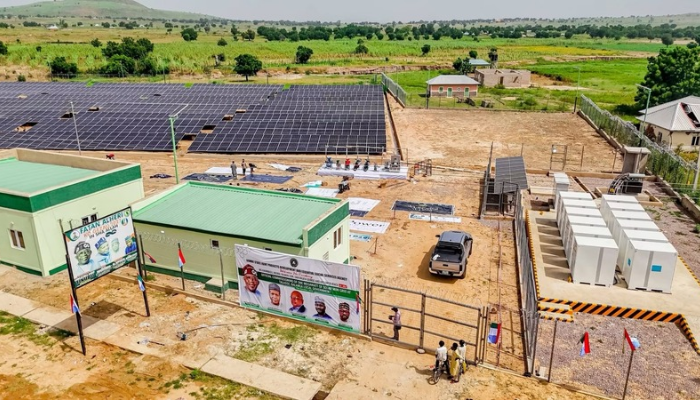
The Federal Government has ended a 17-year power outage in Tallasse, a community in Balanga Local Government Area of Gombe State, with the commissioning of a 1MW solar mini-grid backed by a 2.4MWh battery storage system. The Rural Electrification Agency (REA) delivered the project with the Gombe State Government and a private developer. The ceremony also marked the start of construction on a 16MW network of four interconnected solar mini-grids across the state.
Read also: Solar energy gains traction as SMEs battle rising costs
Power for homes and small businesses
The Tallasse plant already serves 6,028 connections. It also powers productive-use equipment, including facilities for groundnut oil processing, rice milling and flour grinding, as well as electric tricycles. The design aims to turn electricity into income for households and small enterprises, not just light for homes.
Gombe State Governor Muhammadu Inuwa Yahaya said dependable power, combined with agricultural processing capacity, will strengthen local value chains in Balanga. He described the project as proof of close cooperation between the state and the federal government.
A wider 16MW network
The new network will link mini-grids in Dukku, Bajoga, Kumo and Kaltungo. Officials said it will extend dependable electricity to homes, farms, markets and small businesses across Gombe. The projects fall under the Distributed Access through Renewable Energy Scale-up (DARES) programme.
Officials stressed reliability. They noted that access without steady supply limits the benefit of any connection. For that reason, the projects combine battery storage, intelligent monitoring, productive-use equipment and sustainable operating models.
Read also: MAX raises $29m to scale Nigeria’s largest EV mobility platform
Federal strategy on power
The Minister of Power, Joseph Tegbe, described the projects as a practical expression of President Bola Tinubu’s Renewed Hope Agenda. He said the facilities will strengthen public services, reduce dependence on expensive self-generation and attract investment into underserved communities. He also urged residents to protect the installations from vandalism.
The government is pursuing several routes at once. It is strengthening the national grid while it expands mini-grids, embedded generation and solar home systems. It is also arranging dedicated supply for universities, markets and agricultural clusters.
The test now moves from commissioning to operation. Tallasse will show whether battery-backed mini-grids can deliver steady power and keep processing businesses running day after day. Community protection of the assets will matter as much as the engineering. If the model holds, the 16MW network could give small enterprises across Gombe a credible alternative to costly self-generation.