


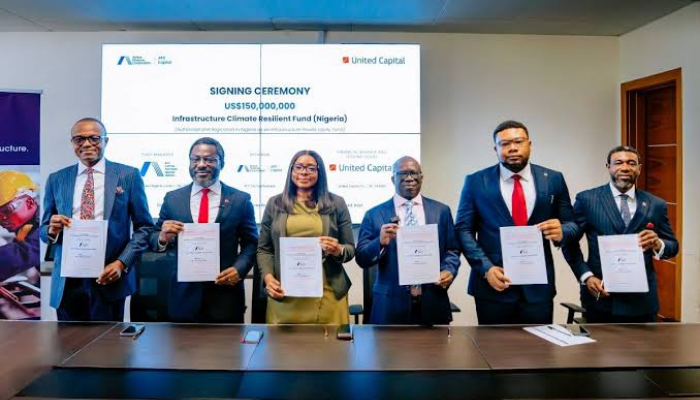
Africa Finance Corporation has announced the launch of a $1.5 billion climate-resilient infrastructure fund targeting critical investments across Nigeria and other high-growth African economies, with a focus on renewable energy, resilient infrastructure, and climate adaptation projects that can attract domestic institutional capital at scale.
The fund, disclosed by AFC President and CEO Samaila Zubairu, is designed to mobilise Nigeria’s pension assets, insurance funds, and development finance into the productive infrastructure the continent needs — converting the institutional capital currently concentrated in government securities into long-term productive investment.
Read also: iDICE Growth Lab opens applications for Nigerian startups with $350,000 in funding
What the fund targets
The fund’s design reflects the AFC’s assessment of where Africa’s infrastructure financing gap is most acute and most addressable. Renewable energy and climate adaptation infrastructure — solar generation, battery storage, water management, climate-resilient agriculture infrastructure, and green industrial facilities — are the primary categories, with a deliberate emphasis on projects that generate the kind of long-term, predictable cash flows that institutional investors require.
Nigeria is identified as a priority market given the scale of its infrastructure needs, the size of its institutional capital base, and the AFC’s existing investment relationships within the country. The $600 million loan to Dangote Group’s Greenview Fertiliser Corp and the $268 million ECOWAS Bank facility to Taraba State — among the largest deals in Nigeria’s Q2 2026 private capital market — demonstrate the AFC’s capacity to structure and execute large transactions in the Nigerian market.
Zubairu said the fund is designed to demonstrate that African institutional capital — pension funds, insurance companies, and sovereign wealth funds — can and should be mobilised for African infrastructure rather than flowing primarily into government securities. Nigeria’s pension industry now manages over N31 trillion in assets, with less than five per cent allocated to infrastructure despite regulatory ceilings that allow significantly higher exposure.
A $1.5 billion fund targeted at climate infrastructure is a meaningful statement of direction. But its real significance lies in whether it succeeds in pulling Nigerian pension and insurance capital into infrastructure investment at scale — because if it does, it establishes a model that could mobilise far more than $1.5 billion over time.
Read also: Wema Bank, EIB Global seal €50m deal to fund Nigerian SMEs focusing on women and youth
The SME dimension
Climate-resilient infrastructure investment creates direct opportunities for Nigerian SMEs across multiple sectors. Renewable energy installations require local engineering, construction, installation, and maintenance services. Climate-smart agricultural infrastructure creates value chain demand for agribusiness SMEs supplying equipment, inputs, and logistics. Green industrial facilities need local supply chain partners at every tier.
For the businesses that currently absorb the cost of unreliable power, climate-driven agricultural disruption, and deteriorating physical infrastructure in their daily operations, the fund’s success would translate into tangible improvements in the operating environment over the medium term.
Read also: World Bank mobilises $100 bn crisis fund as Middle East conflict squeezes Nigerian businesses
Why the timing is significant
The AFC fund launch arrives as global climate finance is under growing scrutiny for its effectiveness in reaching productive investment rather than simply generating commitments. Nigeria’s experience with the World Bank’s $100 billion emergency package, the AfDB’s $200 million BOI facility, and the government’s N729 billion power sector bond has demonstrated both the availability of international capital and the execution challenges that prevent it from flowing into the economy at the pace and scale required.
The right fund structure, targeted at the right assets, with the right institutional capital behind it, can produce infrastructure outcomes that individual government programmes have consistently struggled to deliver. The AFC’s $1.5 billion climate fund will be judged by what it builds, not by what it announces.