


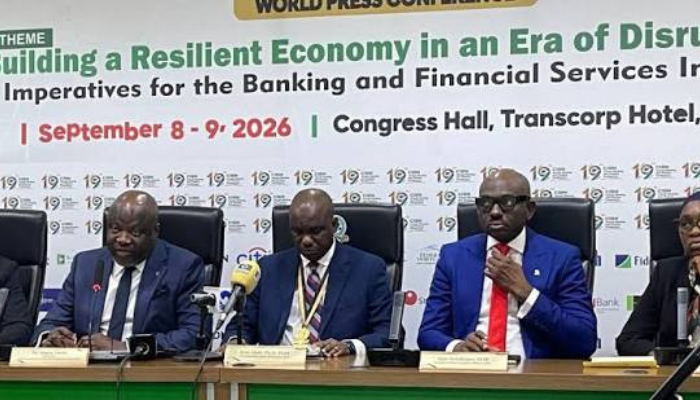
The Chartered Institute of Bankers of Nigeria has called on Nigerian banks to deploy their strengthened post-recapitalisation balance sheets into lending to micro, small, and medium enterprises, warning that macroeconomic gains will remain disconnected from the lives of ordinary Nigerians unless the improved financial sector capacity flows into the productive economy. The call was made by CIBN President and Chairman of Council, Dr Dele Alabi, at the institute’s 19th Annual Banking and Finance Conference, and was reinforced by the World Bank’s Division Director for Nigeria, Dr Mathew Verghis, who stated that credit to Nigeria’s private sector remains inadequate.
Read also: CBN targets stronger FX governance with forthcoming revised manual
The test of recapitalisation
The completion of the CBN’s N4.65 trillion banking sector recapitalisation programme in March 2026 was positioned as a watershed moment for Nigeria’s financial system, creating stronger institutions capable of supporting the economy’s growth ambitions. But Alabi’s remarks at the conference made clear that the CIBN views the strength of a bank’s balance sheet as meaningful only insofar as it is deployed into lending that creates economic value.
“A bigger bank that does not finance a more productive economy is a suboptimal outcome,” the CIBN President said, articulating the institute’s position in terms that applied equal pressure to banks and to the policy environment that shapes their lending behaviour. He described macroeconomic improvements as milestones, not destinations, stressing that the ultimate test of Nigeria’s economic reforms should be their impact on households, businesses, and the daily lives of ordinary Nigerians.
Banks have more capital than they have had in years. The question that the CIBN and the World Bank are both asking, in different ways, is why that capital is not yet reaching the businesses that create the most jobs and generate the most widely distributed income.
Read also: Banks urged to back SMEs, exports in Tinubu’s economic framework
The SME hub proposal
Beyond its call on banks, the CIBN has advanced a structural proposal: the establishment of scalable SME hubs across Nigeria that would provide small businesses with shared infrastructure, business advisory services, skills development, technology support, market linkages, and improved access to finance in a single coordinated location. The proposal responds to a problem that multiple programmes and institutions have identified separately, namely that Nigerian SMEs face a combination of barriers that no single intervention can address in isolation.
A business that receives a loan but lacks the financial management skills to service it will default. A business that has strong governance but cannot access affordable credit cannot grow. A business with viable products but no market linkages cannot generate the revenue to justify additional investment. SME hubs, as the CIBN envisions them, would address all of these constraints under one roof, creating the kind of ecosystem support that has driven small business development in countries that have managed to industrialise their MSME sectors.
Read also: CBN mandates two-year audit for LGAs’ revenue access
What the World Bank added
Verghis’s observation that credit to Nigeria’s private sector remains inadequate despite the recapitalisation was one of the most pointed assessments delivered at the conference. The World Bank’s country data for Nigeria consistently shows that private sector credit as a percentage of GDP is well below both the African average and global benchmarks, a gap that the recapitalisation has not yet visibly closed.
His framing, that the financial system must finance potential and opportunity rather than quick gains for the privileged, set a standard against which the post-recapitalisation lending behaviour of Nigeria’s banks can be assessed in the coming quarters.
The CIBN conference put the right question on the table at the right moment. Nigeria’s banks are better capitalised than they have been in years. Whether they choose to deploy that capital in ways that drive employment, production, and broad-based growth is the judgement that 2027 will be positioned to make.