


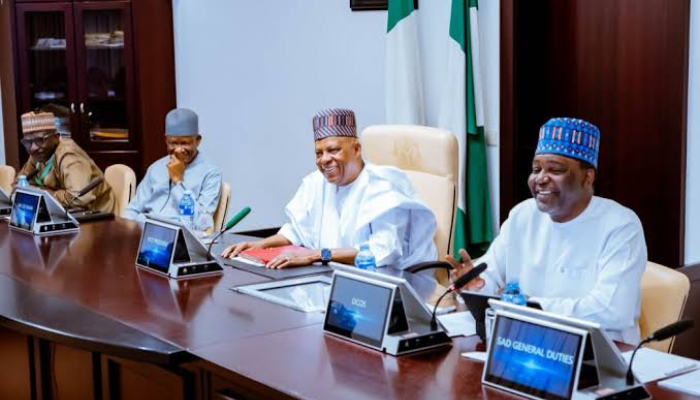
Vice President Kashim Shettima has directed that small business owners be given a stronger voice in how the Federal Government designs and reviews policies that affect them. Speaking at the Micro, Small and Medium Enterprises Stakeholders’ Meeting at the Presidential Villa, Abuja, on Friday, he ordered an expansion of the forum’s membership and told organisers to convene it every quarter.
Read also: VP Shettima urges global support for Nigeria’s agriculture reforms
A forum that must account for its decisions
Shettima instructed Temitola Adekunle-Johnson, Special Adviser to the President on Job Creation and MSMEs, to widen the forum and hold it once every quarter. He also set a test for the meetings themselves. “Business owners must have a more decisive voice in our deliberations, and each meeting must account for the decisions taken at the previous one,” he said.
The second half of that instruction matters as much as the first. A forum that records what was agreed and reports back at the next sitting gives small business owners something they rarely get, which is a way to hold decisions to account.
The Vice President described small businesses as a national priority. He said the smallest shop on a Nigerian street may carry the weight of an entire household, with school fees, a parent’s medicine and an apprentice’s first chance at independence behind its counter. When such a shop closes, he said, the loss travels far beyond its owner.
Read also: Shettima backs skills development with artisan empowerment programme
What the government says it has funded
Shettima listed the administration’s MSME interventions, including the approval of N200 billion in business support. The package comprises N50 billion in grants, N75 billion in loans for MSMEs and N75 billion for manufacturing, with eligible manufacturers able to access up to N1 billion through the Bank of Industry. The fund was launched in October 2023 to cushion the effects of petrol subsidy removal.
The chief executives of SMEDAN, the Nigerian Export Promotion Council, the Nigeria Export-Import Bank and the Industrial Training Fund reaffirmed their commitment to deepening interventions through their agencies. Officials said more support was planned in training and capacity building, market access, affordable finance, grants and production equipment.
Read also: Dangote Refinery takes 32% of NNPC’s July crude sales worth N11bn
What business groups asked for
The business groups present were direct about the gaps. A leader of a women’s business association said most of her members struggle with training, funding, access to international markets and engagement with relevant stakeholders. Solomon Daniel Vongfa, President of the National Association of Small Scale Industrialists, said the numerical strength of MSMEs justified more government support. He called the sector critical to Nigeria’s industrial development.
What happens next
The test will be whether the expanded forum produces measurable follow-through. Access to affordable finance, which both the Vice President and the business groups named, remains the hardest constraint to shift while borrowing costs at commercial banks stay high.
A seat at the table helps only if what is agreed there reaches the shop floor. The quarterly rhythm gives small businesses a calendar against which to measure that.