


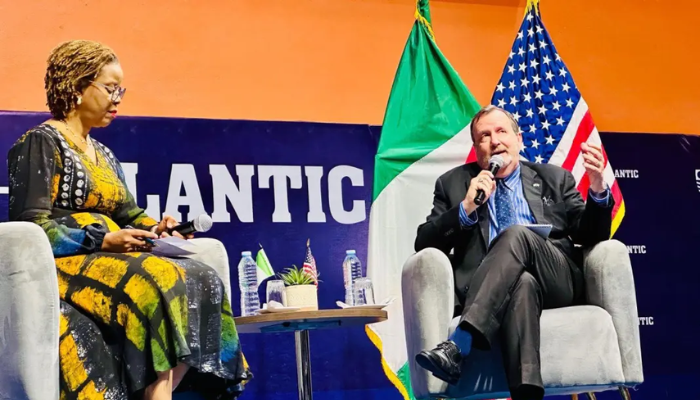
The United States has announced a new approach to its engagement with Nigeria, moving away from an aid-focused model to a trade and investment-led strategy. This shift was outlined by U.S. Ambassador to Nigeria, Richard M. Mills, Jr., during a Fireside Chat held at the Lagos Business School.
The event, themed “Toward a robust U.S.-Nigeria commercial and investment partnership,” brought together policymakers, business leaders, and academics to discuss opportunities and barriers in Nigeria’s business environment.
Read also: FG endorses $25bn Nigeria–Morocco gas pipeline, plans revival of abandoned projects
From aid to trade
Ambassador Mills made it clear that the United States is changing how it engages with Nigeria and other African nations.
“Our approach is clear: from aid to trade,” he said. “We are engaging African nations not as aid recipients, but as capable commercial partners. By promoting two-way trade and investment, we will drive mutual growth for both our nations.”
The U.S. government is working to position Nigeria as a key commercial partner. This direction is part of the new U.S. Commercial Diplomacy Strategy for Sub-Saharan Africa. The strategy, launched last month at the Africa CEO Forum in Abidjan by Ambassador Troy Fitrell, focuses on increasing trade, supporting private sector growth, and enabling long-term economic development across the region.
Read also: Lagos State records N582.45bn revenue in Q1, spends N522bn
Addressing structural barriers
During the session, Ambassador Mills acknowledged the potential of Nigeria’s economy but noted that several issues must be addressed to unlock that potential. He identified regulatory uncertainty, electricity supply challenges, and corruption as major concerns.
He also revealed that the U.S. is looking to support the redirection of Nigeria’s $20 billion annual diaspora remittances into productive investments. One of the steps towards this is ongoing negotiations to eliminate the 10% tariff on Nigerian exports to the U.S.
“We are actively identifying top market reforms needed to improve Nigeria’s business environment based on feedback from both U.S. and Nigerian businesses,” Mills said.
The U.S. is also focusing on improving transparency in policy formulation, encouraging power infrastructure development, and pushing for reforms that promote fair competition for all investors, including those from non-Western countries.
Read also: Russia moves away from traditional foreign aid model
A roadmap for stronger economic ties
To formalise the deepening relationship, the U.S. Department of Commerce and Nigeria’s Ministry of Industry, Trade and Investment have signed a five-year Commercial and Investment Partnership (CIP) agreement. The CIP will focus on agriculture, the digital economy, and infrastructure development.
“The CIP process puts government and business into the same room to remove obstacles to trade,” Mills explained.
He also called on Nigerian policymakers to take steps that will encourage investment and recognise the long-term benefits of U.S. business practices and innovation.
Read also: China introduces new measures to safeguard jobs and exports amid rising trade tensions
Collaboration for growth
Professor Olayinka David-West, Dean of the Lagos Business School, supported the ambassador’s remarks and called for continued collaboration between both countries.
She encouraged stakeholders to combine their strengths to turn current economic challenges into practical and sustainable opportunities.
The event highlighted the growing importance of strategic partnerships in driving private sector-led development in Nigeria and reflected a broader U.S. commitment to commercial engagement across Africa.