


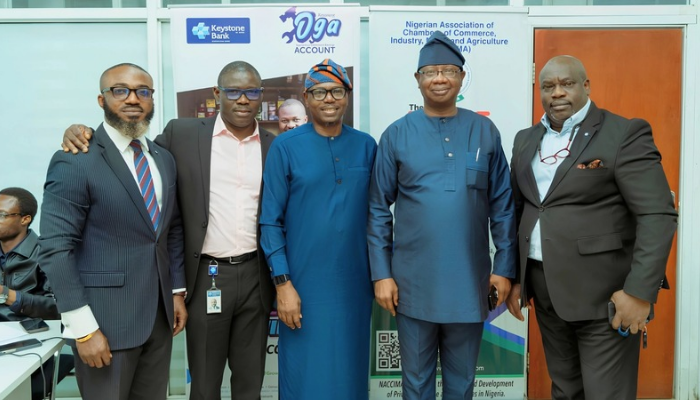
Keystone Bank, in partnership with the Nigerian Association of Chambers of Commerce, Industry, Mines and Agriculture and the Small and Medium Enterprises Development Agency of Nigeria, has delivered a capacity-building programme for small and medium-sized enterprises in Lagos, targeting the specific knowledge gaps that are keeping Nigerian entrepreneurs out of the formal credit system.
The sessions identified poor record-keeping and confusion over tax obligations as the most common barriers preventing small businesses from accessing finance — problems that no amount of loan disbursement can solve if left unaddressed.
Read also: CBN reshuffles deputy governors as apex bank realigns leadership
What the sessions covered
The programme was structured around four areas that directly determine whether a small business qualifies for bank financing: credit and investment readiness, tax and regulatory compliance, financial management, and business-scaling strategies. Participants received practical guidance on how to structure their businesses in ways that make them legible to lenders, how to maintain the records that credit assessors look for, and how to navigate the tax obligations that most small business owners find confusing and opaque.
Group Head of Retail and Digital Banking at Keystone Bank, Olayemi Sule, was direct about the bank’s motivation. Access to funding remains important, she said, but entrepreneurs also need practical knowledge in business management, regulatory compliance, and investment readiness if they are going to build sustainable enterprises. Finance without those foundations does not produce the outcomes that either the bank or the borrower needs.
The training reflects a recognition that has been slow to arrive in Nigerian banking: the gap between available credit and credit actually reaching small businesses is not primarily a supply problem. It is a preparedness problem — and banks that only lend without also building capacity are solving half the equation.
Read also: Experts say MSMEs must build systems, data and governance to scale
The partnership model
Keystone Bank has built a broad network of institutional partnerships to extend its SME engagement beyond conventional banking relationships. Beyond NACCIMA and SMEDAN, the bank collaborates with the Lagos and Kano Chambers of Commerce, the National Association of Small-Scale Industrialists, the Association of Small Business Owners of Nigeria, and the Kaduna State Enterprise Development Agency — a footprint that allows the bank to reach business communities across multiple regions and sectors rather than concentrating SME engagement in Lagos alone.
NACCIMA Director-General Olusola Obadimu, who participated in the Lagos programme, described the collaboration as a practical demonstration of how financial institutions and business associations can work together to remove the structural obstacles that keep small businesses from reaching their potential.
Read also: Polaris Bank, NACCIMA inaugurate Export Express Support Centre to scale non-oil trade
What it means for small businesses
The issues the training addressed — poor records, tax confusion, unclear business structure — are not unique to the participants in Lagos. They are endemic across Nigeria’s MSME sector, and they explain a significant part of why formal bank credit continues to be inaccessible to most small businesses even as more capital theoretically becomes available through recapitalisation and development finance programmes.
A business that cannot show a clear record of its revenues, expenses, and liabilities is a business that a lender cannot assess. Training that closes that gap is not a soft intervention — it is one of the most direct ways to convert available credit into credit actually disbursed.