

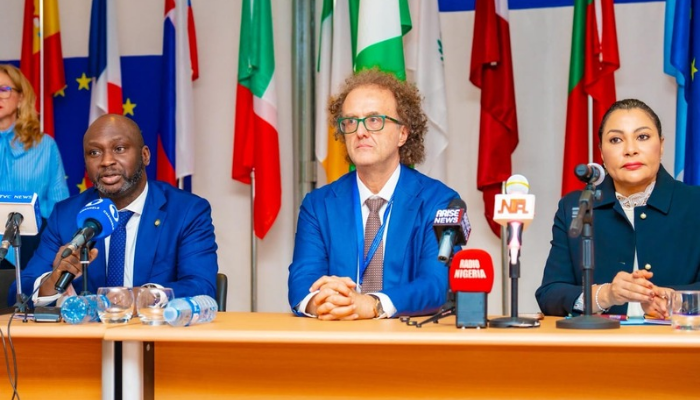
The Bank of Industry and European Investment Bank have signed two financing agreements totalling €135 million, channelling EU-backed capital directly into Nigeria’s agricultural value chains and healthcare manufacturing sector. The deals, signed during the eighth Nigeria-EU Ministerial Dialogue in Abuja in March 2026, form part of a broader €290 million investment package under the EU’s Global Gateway Strategy and represent one of the more significant injections of structured long-term financing into productive sectors of the Nigerian economy in recent years.
Read also: Tinubu seeks Senate approval for $516m loan to fund Sokoto-Badagry superhighway
Where the money goes
The first agreement allocates €50 million as a credit line to support local manufacturers of pharmaceuticals, vaccines, and diagnostic tools. The facility is designed to create a sustainable financing mechanism for Nigerian SMEs and mid-sized companies to scale healthcare production capacity, improve quality standards, and reduce the country’s heavy reliance on imported medical products.
The second agreement commits €85 million to agricultural value chains, with at least 70 per cent of loans directed at cocoa and dairy production. Private sector companies, cooperatives, and MSMEs across these value chains are eligible for funding, with technical assistance from EIB included to support climate risk management and environmental compliance.
The critical difference between this and previous interventions is structure. Rather than broad credit access, these facilities are tied to specific value chains, performance standards, and technical support — a combination designed to improve project viability rather than simply increase the volume of capital available.
Read also: How a fuel crisis pushed Nigeria’s airlines to the edge and what it means for business
Why analysts say structure matters more than scale
Nigeria’s challenge is no longer purely about access to capital. The BoI Managing Director Olasupo Olusi acknowledged this directly, describing the agreements as a shift from short-term financing toward long-term investment aligned with national development priorities. The EIB has committed over €2.3 billion to Nigeria since 1978, including investments in agribusiness logistics and SME financing. The new agreements extend that record into sectors where Nigeria has both pressing needs and significant untapped potential.
For agribusiness SMEs operating in cocoa and dairy, the facility provides access to financing that has historically been unavailable at the scale and tenor needed to fund meaningful expansion. For health manufacturers, it opens a structured pathway to the kind of capital that supports moving from small-scale production to competitive regional manufacturing.
Read also: How to use what you have to get what you want
The broader implication
The agreements align with the African Union’s target of producing 60 per cent of vaccines and essential medicines on the continent by 2040, and with AfCFTA’s framework for regional trade. For Nigerian SMEs, the practical meaning is a more accessible route to long-term, affordable financing in sectors where growth can create jobs, reduce import dependence, and generate export revenue.
Investment of this kind only delivers on its potential if implementation is rigorous. The combination of EIB technical support and BOI’s on-lending infrastructure gives this facility a better chance than most of reaching businesses that genuinely need it.