

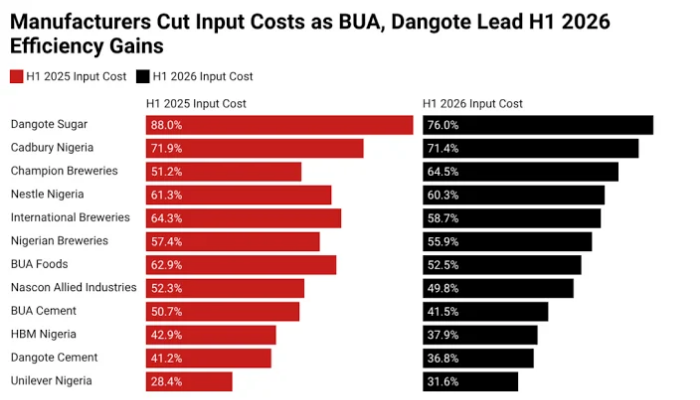
Nigeria’s major listed manufacturers significantly reduced the share of revenue absorbed by production costs in the first half of 2026, pointing to an emerging improvement in cost efficiency as inflationary pressures began to moderate and exchange-rate conditions became more predictable.
An analysis of 12 major companies across consumer goods, food, beverages, and cement shows that aggregate cost of sales fell to N3.38 trillion in H1 2026, from N3.45 trillion in H1 2025, even as combined revenue rose to N7.19 trillion from N6.44 trillion — meaning businesses earned more while spending less on production as a proportion of what they generated.
Read also: Nigerian SMEs push for dedicated banks as data shows only 15% access formal loans
What improved and why
The cost-to-revenue ratio across the surveyed companies declined from approximately 53.5 per cent in H1 2025 to around 47 per cent in H1 2026 — a meaningful shift that reflects the cumulative effect of several concurrent improvements. Headline inflation fell from 24.94 per cent in July 2025 to 15.43 per cent in July 2026, reducing the year-on-year pressure on input prices. The naira stabilised within a narrower trading band following the 2023 and 2024 devaluations, reducing foreign exchange losses that had devastated margins at import-dependent manufacturers. And domestic refining capacity — with the Dangote Refinery now supplying most of Nigeria’s petrol and diesel needs — eased some of the energy cost pressure that had been running at extraordinary levels through 2024 and early 2025.
Among specific companies, BUA Foods reduced its cost of sales from N281.2 billion to N218.9 billion while maintaining a profit rise to N142.3 billion despite lower revenue. Nigerian Breweries improved cost efficiency meaningfully as raw material costs eased. The cement sector’s aggregate cost of sales fell to 37.8 per cent of revenue from 42.6 per cent, with finance costs alone dropping N117 billion as interest rate conditions eased from their peaks.
A 6.5 percentage point improvement in cost-to-revenue ratio across Nigeria’s largest manufacturers is not a rounding error. It represents billions of naira moving from production costs to profit — funds that can be reinvested, used to reduce prices, or deployed to service debt that has been accumulating through years of margin compression.
Read also: Nigerian banks slashed N5.45tn in loans to 8 key sectors in 2025 as CBN ended forbearance
The caution that comes with it
The BusinessDay analysis notes that the improvement may prove short-lived. Renewed food price acceleration in July — food inflation jumping from 17.52 per cent to 20.31 per cent in a single month — signals that input cost pressures have not fully resolved. The US-Iran truce collapse and renewed Hormuz uncertainty have returned upward pressure to global crude and energy prices that Nigerian manufacturers cannot fully insulate themselves from.
Companies have also been adapting through strategies that limit their exposure to demand risk rather than genuinely expanding output. FMCG firms cut unsold inventories by 16 per cent in Q1 2026, while raw material holdings fell 33.8 per cent — signals of cautious, demand-led production rather than confident expansion. Smaller pack sizes and portfolio pruning are visible across multiple consumer goods categories, suggesting the cost improvement reflects operational efficiency rather than a fundamental demand recovery.
Read also: 1,000 export containers trapped at Apapa Port as vessel shortage exposes Nigerian exporters
What it means for SMEs
For small businesses that supply raw materials, packaging, logistics, or distribution services to these large manufacturers, the improvement in large company margins is an indirect positive — healthier corporate balance sheets sustain procurement budgets and reduce the risk of payment delays that ripple through supply chains.
Nigeria’s manufacturing sector is beginning to breathe more easily. Whether that breath deepens into genuine expansion or remains a cautious stabilisation will depend on whether the cost improvements of H1 2026 hold through a second half that is starting with food inflation reaccelerating and energy risks returning.