

Nigeria’s ambitious Industrial Policy 2025 risks becoming the latest in a long line of well-designed policy frameworks that fail to reach the businesses they were created to support, as a new assessment by the Alliance for Economic Research and Ethics finds a widening gap between the commitments the policy makes and the conditions that Nigerian entrepreneurs actually face.
AERE Chairman Dele Oye, a former National President of the Nigerian Association of Chambers of Commerce, Industry, Mines and Agriculture, has called on the government to shift its energy from policy formulation to disciplined, measurable implementation.
Read also: 8 million Nigerian businesses shut down in 18 months as SME crisis deepens
What the policy promises
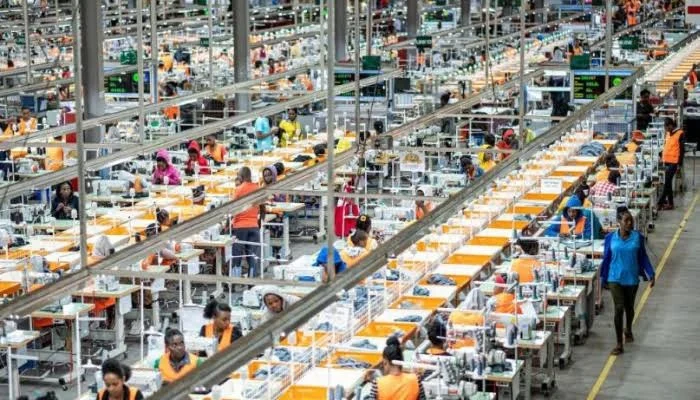
The NIP2025 is, by technical standards, a comprehensive document. It targets raising manufacturing’s contribution to GDP from its current level to 15 per cent by 2030 and 25 per cent by 2035 — ambitions that would require a fundamental transformation in how Nigeria’s productive sector is financed, powered, and supported. The policy explicitly identifies MSMEs as central to achieving those objectives, committing to single-digit loan access, industrial clusters, technology incubation centres, skills development programmes, and fiscal incentives designed to reduce the cost of doing business.
Oye’s assessment is not that these commitments are wrong. He described NIP2025 as comprehensive, evidence-based, and aligned with continental frameworks including the AfCFTA. The problem, he argued with considerable specificity, is the distance between what the document says and what Nigerian entrepreneurs experience when they walk into a bank, pay their generator bill, or try to understand the taxes they owe.
For millions of Nigerian entrepreneurs struggling to survive, the NIP2025 reads less like a practical roadmap and more like a distant promise. That sentence is worth sitting with — because it describes not a policy failure but an implementation failure, and the two require entirely different responses.
The daily reality the policy must reach
The AERE assessment was built on data that the policy itself acknowledges but has yet to adequately address. SMEs contribute 46.32 per cent of Nigeria’s GDP and account for approximately 87.9 per cent of total employment. Yet fewer than one in 20 has access to formal bank credit. Commercial lending rates exceed 35 per cent at many institutions. Energy costs consume more than 40 per cent of profits for many small manufacturers. Multiple taxation, inconsistent regulation, and infrastructure gaps add further layers of cost and uncertainty to an operating environment that the policy identifies as a constraint but has not yet meaningfully changed.
The BOI disbursed a record N644.9 billion in 2025 — a genuine and significant milestone. AERE acknowledged this progress. But Oye argued that financing alone, however large the volume, will not deliver the industrial transformation the policy targets unless the structural constraints that prevent businesses from using capital productively are simultaneously addressed.
Lending more money into a broken operating environment does not fix the environment. It funds businesses that then struggle to survive in it.
Read also: SMEDAN says Nigeria lacks investment-ready startups, launches trainer programme to fix the pipeline
What implementation fidelity actually requires
AERE’s prescription is straightforward even if the execution is not: stronger institutional support for SMEDAN, expanded and more accessible BOI funding, sustained investment in power infrastructure, consistent enforcement of existing regulations rather than the introduction of new ones, and a single-window approach to business registration and compliance that reduces the administrative burden on small operators.
Oye also cautioned against programmes that substitute visibility for impact — citing grant competitions and award schemes as examples of interventions that benefit a small number of winners while leaving the underlying structural constraints that determine whether most businesses survive entirely unchanged.
The government’s response to these assessments will be measured not in policy revisions or press conferences but in whether the operating conditions that have made Nigeria one of the most difficult environments in which to build and sustain a small business begin to change — and whether the businesses that have survived thus far can feel that change in their monthly costs, their access to credit, and the reliability of the infrastructure they depend on every day.