

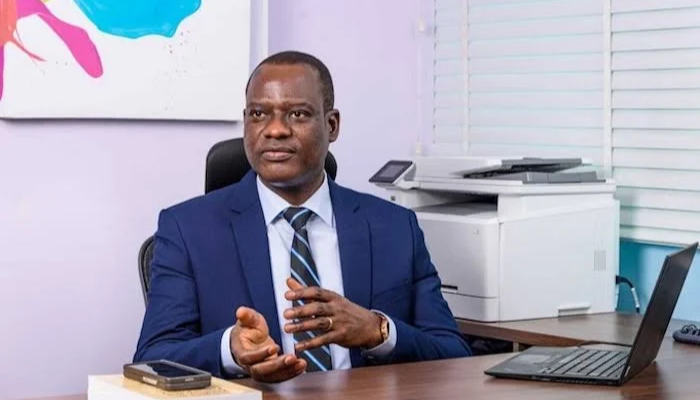
Taiwo Oyedele, the technocrat who spent nearly three years designing Nigeria’s most ambitious tax reform programme in decades, has taken full charge of the country’s fiscal direction as Minister of Finance and Coordinating Minister of the Economy, with a clear mandate to move from policy formulation to measurable execution.
For Nigerian SMEs navigating the early months of the Nigeria Tax Act 2025, the transition signals that the person most responsible for the framework now owns responsibility for what it delivers.
Read also: Proposed tax reform expected to reduce burden on small businesses
From committee chair to Finance Minister in five weeks
Oyedele’s ascent was unusually swift. Appointed chairman of the Presidential Committee on Fiscal Policy and Tax Reforms in July 2023, he spent the following 32 months driving the consolidation of more than 60 taxes into fewer than 10 statutes, shepherding four reform bills through the National Assembly in May 2025, and overseeing the creation of the Nigeria Revenue Service as a unified replacement for multiple revenue agencies.
In March 2026, he was confirmed by the Senate as Minister of State for Finance. Thirty-six days later, President Tinubu elevated him to the substantive role of Minister of Finance and Coordinating Minister of the Economy, replacing Wale Edun, who departed on health grounds. The reforms he designed took effect on 1 January 2026 — meaning Oyedele arrived in the finance ministry just as their implementation was beginning.
Moving the architect of a reform into the institution responsible for executing it is either the most efficient possible policy structure or a concentration of accountability that leaves no one else to blame if it goes wrong. Either way, the incentives are aligned.
Read also: Nigerians task FG, states on proper deployment of tax revenue
What the reforms mean for small businesses
The Nigeria Tax Act 2025 introduced changes that directly benefit the smallest businesses. Companies with annual turnovers below N100 million are now exempt from company income tax, up from the previous N50 million threshold. Nigerians earning N800,000 or less annually pay zero income tax. VAT on basic food items, medicines, and educational materials has been set at zero per cent. Stamp duty deductions on government contractor payments have been removed.
Together, these measures reduce the compliance burden and tax cost for Nigeria’s smallest formal businesses — the segment most likely to have been deterred from formalisation by the previous complexity and cost of the tax system.
Oyedele has been direct about what he considers the central challenge now: not policy design, but execution. In his assumption-of-office statement, he described Nigeria as being at a critical economic juncture where sustaining and expanding gains will require disciplined implementation, accountability, and measurable results. Good policy design alone is not enough, he said. Success will be defined by execution.
Read also: Tax reforms take effect, impacting MSMEs compliance and growth
What SMEs and the business community are watching
Industry stakeholders have broadly welcomed Oyedele’s appointment but are watching closely for whether the reform benefits materialise in practice. Daniel Dickson-Okezie of the LCCI described the operating environment as still deeply challenging, citing persistent power costs, customs inefficiencies, and the gap between tax reform legislation and the experience of businesses dealing with regulatory agencies on the ground.
The 2026 National Tax Forum, convened by the University of Lagos and Nodeori Group on 2 July 2026, surfaced questions that reflect the business community’s core concerns: will the reforms simplify compliance, encourage formalisation, reduce multiple taxation, and improve administration through technology — or will implementation gaps allow the old frictions to persist under a new name?
Nigeria has passed better tax laws before. What it has rarely managed is the enforcement environment, inter-agency coordination, and political continuity needed to make them work consistently for the businesses they were designed to support. That is the challenge Oyedele now owns.