

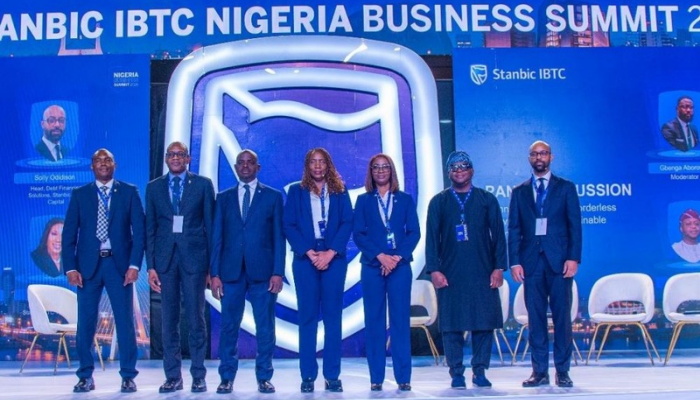
Stanbic IBTC Bank has launched a nationwide regional tour of its Nigeria Business Summit, extending the initiative beyond Lagos to bring practical SME support, funding access, and business advisory services directly to entrepreneurs in four of Nigeria’s most commercially significant cities.
The tour follows the inaugural Lagos edition of the summit which attracted nearly 2,000 physical attendees, with the bank describing the regional expansion as a deliberate strategy to engage small businesses within their own operating environments rather than requiring them to travel to the commercial capital.
Read also: Stanbic IBTC places SME growth at the centre of inaugural Nigeria Business Summit
The cities, the dates, and what is on offer
The regional tour has already commenced, with the Onitsha leg holding on 1 July 2026. The Aba edition took place on 8 July, with Ibadan scheduled for 15 July and Kano to follow on 5 August 2026. Each event is structured around expert-led masterclasses, panel discussions, and networking exhibitions covering trade readiness, working capital management, funding readiness, and enterprise sustainability.
A defining feature of the tour is the deployment of on-site enterprise clinics — one-on-one advisory sessions between business owners and Stanbic IBTC relationship managers and financial specialists covering access to finance, digital banking solutions, and business expansion strategies. Businesses also have the opportunity to showcase their products and build connections with potential partners and customers within their local markets.
Moving the summit to Onitsha, Aba, Ibadan, and Kano is not simply a geographic expansion. It is an acknowledgement that the businesses driving employment and trade in those cities have been underserved by financial institutions that have historically concentrated their SME engagement in Lagos.
Read also: Nigeria’s capital inflows hit $10.37bn in Q1 2026, FDI decline signals investment gap
What Stanbic IBTC is building in Aba
The Aba edition was delivered in partnership with the Abia State Government, whose Executive Director of Business and Commercial Banking, Remy Osuagwu, described the bank’s approach as taking support beyond traditional banking by delivering business education, advisory services, capacity-building programmes, and financing access directly to entrepreneurs in the field.
Abia State officials used the summit to announce plans for a comprehensive State MSME Policy, a statewide MSME Directory to improve business visibility, and the National Brands Development and Made-in-Nigeria Project, an initiative to showcase locally manufactured goods and position Abia as Nigeria’s preferred destination for quality local production. The convergence of state policy ambition and private sector delivery capacity in a single event reflected exactly the kind of partnership the bank said it was trying to build across the country.
Head of Enterprise Banking at Stanbic IBTC, Olajumoke Bello, in a commentary published alongside the tour, identified two structural gaps that the initiative is designed to address: the gap between financial readiness and available funding, where businesses lose access to capital not because it does not exist but because they do not know how to structure their finances to qualify for it; and the gap between operating locally and competing beyond it, where businesses remain trapped in highly localised markets without the networks or exposure to unlock new growth.
Read also: PEBEC halts new government policies to shield businesses from regulatory disruption
Why this model matters
The regional tour reflects a practical insight that has often been missing from Nigerian financial institutions’ SME strategies: that the businesses most in need of support are rarely the ones showing up at Lagos conferences. They are the garment producers in Aba’s Ariaria market, the traders in Onitsha’s main market, the food processors in Ibadan, and the manufacturers in Kano’s industrial clusters — businesses that have the volume, the viability, and the ambition, but not the access.
When a bank’s relationship managers are sitting across from an entrepreneur in Aba giving one-on-one advice about how to become credit-ready, that is a fundamentally different form of SME engagement from a panel discussion in Lagos. It is the form that actually changes outcomes.