

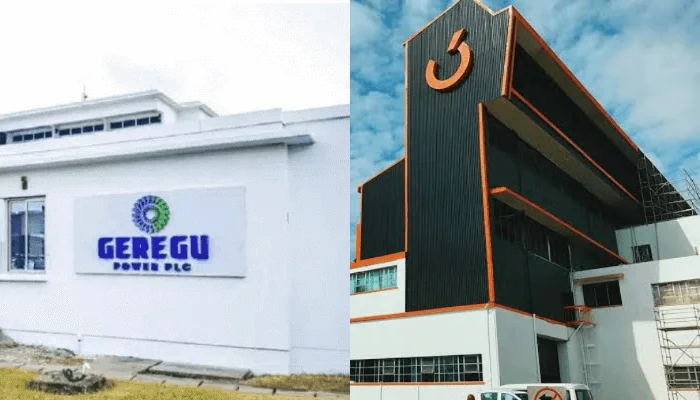
Geregu Power Plc has defaulted on its N40.09 billion Series 1 Senior Unsecured Bond, missing both its eighth semi-annual coupon payment and its scheduled fourth principal bullet repayment, according to an updated listing status published by FMDQ Securities Exchange.
The default marks the first major bond default by a listed Nigerian power generation company and arrives eight months after billionaire Femi Otedola sold his controlling stake in the company to MA’AM Energy Limited — a vehicle linked to Senator Abdulaziz Yari — in a $750 million debt-financed transaction.
Read also: Nigerian firms’ profits rise 73% as Naira stability drives five-year high
What triggered the default
The immediate cause of Geregu’s inability to meet its bond obligations is a N61.47 billion major turbine maintenance and overhaul programme that has significantly curtailed the company’s generating capacity and, with it, its revenue-generating ability. For the six months ended 30 June 2026, Geregu’s revenue fell 78.71 per cent to N18.65 billion from N87.63 billion in the same period of 2025. Profit after tax plunged 88 per cent, from N20.27 billion to N2.54 billion.
The collapse in revenue was most severe in the second quarter, when Geregu generated just N419.1 million — against N55.87 billion in Q2 2025 — as turbines undergoing overhaul remained offline. The company had projected N57.11 billion in revenue and N12.02 billion in profit after tax for Q1 2026 alone; actual first-half results fell dramatically short of those targets.
A turbine overhaul that reduces quarterly revenue to less than one per cent of the prior year is not a minor operational interruption. It is a fundamental disruption to the company’s cash generation — and when that disruption coincides with scheduled debt repayments on a N40 billion bond, the outcome is the one FMDQ has now formally listed.
Read also: Power crisis driving inflation, job losses and factory shutdowns across Nigeria — advocacy group
The ownership context
The default comes eight months after MA’AM Energy Limited, whose four known shareholders each hold 25 per cent stakes, completed its acquisition of 95 per cent of Amperion Power Distribution Company — the vehicle through which Otedola held beneficial ownership of 77 per cent of Geregu’s issued share capital. The $750 million transaction was financed by a consortium of Nigerian banks led by Zenith Bank, with BlackBirch Capital as adviser.
Otedola’s daughter Olawunmi Otedola resigned as a non-executive director as part of the ownership transition, alongside four independent directors. The default has prompted financial analysts to draw direct attention to the timing — and to question whether the new ownership structure has the operational and financial management depth needed to navigate a period of compressed cash flows while servicing the substantial debt the acquisition itself generated.
Read also: Niger Delta MSME empowers entrepreneurs with N3 million grant
Market and investor reaction
Geregu’s share price has fallen 27.67 per cent since the start of 2026, declining from N1,141.50 to N825.70 as of 7 August — a market signal that investors have been repricing the company’s earnings outlook for some months ahead of the formal default announcement. Financial analyst Olumide Adesina noted that in a more liquid market, a bond default of this nature would likely have triggered an overnight loss of at least a fifth of the company’s equity value.
Despite the default, GCR Ratings retained Geregu Power’s national scale long-term issuer rating at A(NG) with a Stable outlook, citing the company’s assessment that the maintenance programme is temporary and that generating capacity will be restored once the overhaul is complete.
Read also: Nigeria approves N185 billion payment for gas debts to boost power supply
Why it matters for Nigeria’s energy sector
Geregu’s bond default is more than a company-specific event. It signals that the financial pressures bearing down on Nigeria’s electricity generation sector — elevated maintenance costs, constrained transmission access, and tight liquidity — are capable of pushing even listed, formerly high-performing GenCos into debt service failure.
For the broader energy financing market, a default of this scale by a listed generation company raises the risk premium attached to power sector bonds at exactly the moment when Nigeria needs more private capital flowing into electricity infrastructure. The N729 billion government bond issued to settle legacy GenCo debts earlier this year was designed to restore sector liquidity; Geregu’s default signals that liquidity problems in the sector are not limited to what the government owes the generators.
Nigeria cannot build the power infrastructure its economy needs while the companies building it are defaulting on their bonds. The Geregu situation is a data point in a much larger argument about whether Nigeria’s power sector financing model is structurally sound — and the answer, right now, is not reassuring.