

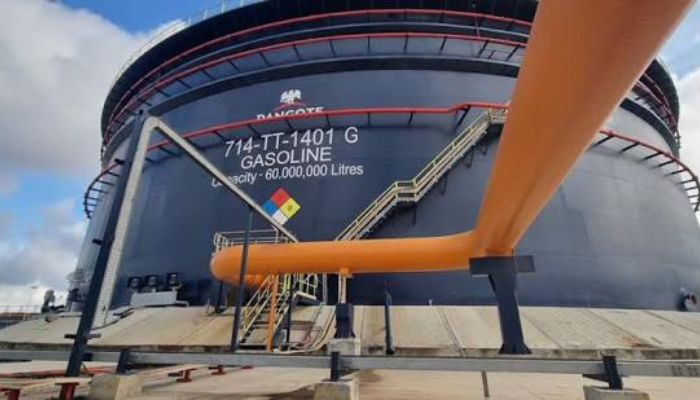
Even as global crude prices fell sharply following the US-Iran peace deal announcement, the Dangote Petroleum Refinery has maintained its gantry price for Premium Motor Spirit at N1,250 per litre — a position that has opened a significant and increasingly visible gap with the cost of imported petrol and intensified concerns among fuel marketers and businesses waiting for price relief at the pump.
Read also: Dangote refinery emerges as world’s largest jet fuel exporter, plans $10bn expansion
The pricing gap
New data from the Major Energy Marketers Association of Nigeria shows that the landing cost of imported petrol has fallen to N1,117 per litre as of early June 2026 — N133 per litre below what Dangote charges at the gantry. With Brent crude now trading at around $82 to $87 per barrel and expected to fall further as the Strait of Hormuz reopens, the gap between domestic refinery pricing and the true cost of supply is likely to widen further unless Dangote adjusts its price downward.
A N133 per litre gap between what imports cost and what the dominant domestic refinery is charging is not a rounding difference. It represents a pricing floor that is keeping fuel costs elevated for every business in Nigeria even as the global input cost falls away beneath it.
Read also: Crude supply boost targets Dangote refinery output
Why the refinery has not moved
Dangote Refinery has previously adjusted its gantry prices in response to crude oil movements, reducing rates at certain points during the conflict period. The refinery’s pricing decisions are influenced by the cost of crude it already holds in inventory — crude purchased at higher prices during peak conflict conditions. As those stocks are worked through, the pathway to lower pump prices becomes clearer, but the timing depends on the refinery’s inventory cycle rather than the day-to-day movements of global crude benchmarks.
The refinery has also publicly advocated for a crude-for-naira policy that would allow it to purchase Nigerian crude in local currency, reducing its foreign exchange exposure and theoretically enabling more competitive domestic pricing. That policy has not been fully implemented, and the currency dimension continues to affect how quickly global price movements translate into domestic price relief.
Read also: Concerns grow over Dangote refinery influence on Nigeria’s petrol supply market
What it means for businesses
For Nigerian SMEs, the gap between where global crude prices are heading and where domestic fuel prices currently sit is a source of genuine frustration. Businesses that have reorganised operations, cut costs, and deferred investment decisions around high energy costs are watching global prices fall while their generator bills and logistics costs remain largely unchanged.
Fuel marketers have raised concerns through MEMAN, noting that the pricing environment makes it difficult to compete with the refinery while also struggling to pass savings on to consumers. Until Dangote moves its gantry price in line with declining crude costs, the relief that the US-Iran peace deal promises for Nigerian businesses will take longer to materialise than the global headlines suggest.
The peace deal is real, the crude price decline is real, and the direction of travel for fuel prices in Nigeria is now clearly downward. But the speed at which that relief reaches small businesses will depend on decisions made in Dangote’s pricing room, not in Washington or Tehran.