


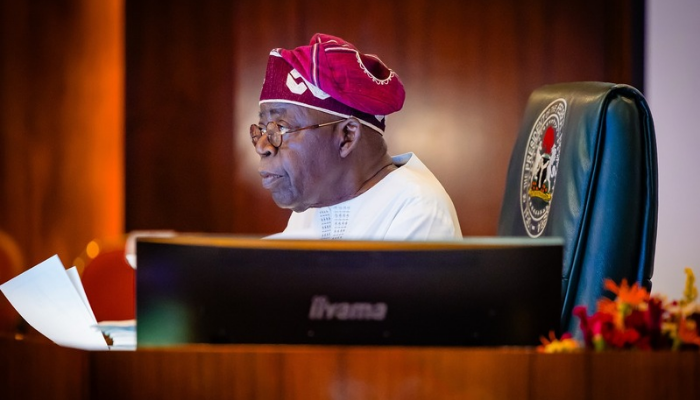
President Bola Tinubu has signed the Presidential Executive Order on Virtual Assets Coordination, 2026, establishing a unified inter-agency framework to regulate virtual assets in Nigeria with immediate effect.
The order creates a Virtual Asset Council chaired by the Central Bank of Nigeria, with the Securities and Exchange Commission and the Nigeria Revenue Service serving as vice-chairs, bringing together financial, capital market, revenue, intelligence, and national security agencies under a single coordinating structure for the first time.
Read also: Nigerian banks slashed N5.45tn in loans to 8 key sectors in 2025 as CBN ended forbearance
Why the order was necessary
The order directly addresses a problem that has persisted in Nigeria’s digital asset sector for years: regulatory fragmentation that allowed overlapping responsibilities among agencies to create both gaps and conflicts. The CBN banned banks from servicing crypto exchanges in 2021, the SEC introduced a different framework for virtual assets as securities, and the NRS developed separate tax positions — three agencies operating in silos, each with legitimate mandates that did not sufficiently align.
The Presidency described the resulting environment as one that exposed the country to money laundering, terrorism financing, cybersecurity threats, data privacy risks, fraud, and revenue losses, while simultaneously slowing the development of a legitimate digital asset industry that hundreds of thousands of Nigerians were already participating in regardless of the regulatory confusion.
When regulators compete rather than coordinate, the people who benefit most are not consumers or legitimate businesses. They are the bad actors who understand how to exploit the gaps between jurisdictions. The Virtual Asset Council is designed to close those gaps systematically.
Read also: CBN revokes 46 microfinance bank licences as regulatory crackdown deepens
What the order creates
Beyond the council, the order establishes a Virtual Asset Office domiciled at the CBN to serve as the operational secretariat, coordinating information sharing, processing licence applications, and reporting across agencies through an integrated supervisory technology platform. Under the framework, virtual assets classified as securities will continue to be regulated by the SEC, while payment, settlement, custody, and related services involving non-security virtual assets will fall under the CBN’s oversight.
The CBN has been directed to establish a regulatory sandbox for the virtual assets industry, enabling qualified operators to test products and blockchain-based services under supervision before full market launch. The NRS will issue a dedicated tax policy for the sector, and the Virtual Asset Council must produce a Harmonised Implementation Framework within 30 days. The Federal Government is also finalising a comprehensive Virtual Assets White Paper outlining Nigeria’s long-term policy direction.
Read also: CBN launches payments system vision targeting 95% financial inclusion
What it means for Nigerian fintech SMEs and crypto businesses
Nigeria’s virtual asset sector had been growing significantly even under regulatory uncertainty. The Binance crisis in 2025, which led to the detention of the company’s executive and billions in fines, underscored both the scale of Nigeria’s crypto activity and the government’s willingness to act aggressively when it felt the sector was destabilising the naira or facilitating capital flight.
The executive order signals a more structured approach — one that seeks to regulate, tax, and channel digital asset activity rather than suppress it. For Nigerian fintech SMEs building on blockchain infrastructure, payment settlement rails, and digital asset custody, the creation of a regulatory sandbox is particularly significant: it provides a supervised environment to test innovations without requiring full compliance with a framework that may not yet fully account for new product categories.
Nigeria has one of the highest rates of crypto adoption in the world. An executive order that acknowledges that reality and builds a regulatory framework around it — rather than one that pretends the activity does not exist — is a more honest and ultimately more effective approach to governing a market this large.