

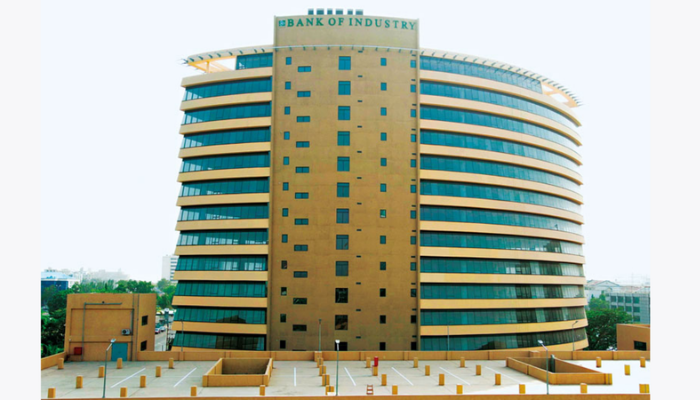
The Bank of Industry says it is looking for cheaper sources of funding as it sits on more than N2 trillion in loan applications waiting to be financed. Managing Director Olasupo Olusi said the bank will return to the Eurobond market only if the cost is competitive, and is exploring concessional loans from development finance institutions instead. The remarks were first reported on 2 November.
Read also: Bank of Industry disburses N636 bn to 7,000 businesses, supports 1.6 million jobs
A pipeline bigger than a year of lending
Olusi said the bank’s pipeline of applications worth more than N2 trillion makes extra capital raising necessary. For scale, BOI disbursed N645 billion in 2025, its highest ever and 26 per cent above the ₦510 billion of 2024, according to figures Olusi gave at an earlier briefing. The pipeline is therefore more than three times what the bank lent last year.
At that briefing he also said MSMEs received over 41 per cent of 2025 funding against a 35 per cent target, and that the bank is aiming for N1.35 trillion in annual loans by 2027.
Where the money could come from
Olusi said BOI has secured a $200 million concessional facility from the African Development Bank, with a 10-year repayment period. Of any new Eurobond, he said, “if a new bond is too expensive, we won’t even go back.” The bank is also in talks with partners including the African Development Bank and the Agence Française de Développement, and is looking at domestic capital markets.
BOI has also added non-interest banking products, widening the structures available to eligible businesses.
Read also: TBH, Sterling Bank open N10m funding window for MSMEs through pitchathon
Helping small firms qualify
For MSMEs, Olusi pointed to two measures. The bank has accredited auditors to help businesses improve their financial records and meet lending requirements, which targets the bookkeeping weakness lenders often cite. It has also accessed a $50 million Federal Guarantee Fund to reduce lending risk, particularly for MSMEs supported by local governments.
On agriculture, he said BOI works with the Bank of Agriculture, focusing on processing, manufacturing and other downstream activity, and supports aggregators who finance inputs and equipment for smaller farmers while buying their produce. BOI accounted for 6.5 per cent of the N3.4 trillion of credit to agriculture in the period reviewed, he said, and he called on other institutions to contribute more.
Impact and outlook
BOI’s 2025 impact report, audited by KPMG, shows its activities funded 1.68 million jobs. Olusi said the bank is tightening its impact reporting so that claims can be verified. Its digital sector programme is expected to attract more than $600 million over the coming years, while climate and sustainability projects are still being developed. He declined to give a 2026 financing target, saying only that the bank aims to beat 2025.
Read also: Fidelity Bank bets on local insight to unlock Northern SME growth
Why it matters for small businesses
The price BOI pays for its money sets the price its borrowers can be offered. A cheaper source such as a 10-year concessional facility lets the bank lend for longer at lower cost, which is what manufacturers and small firms say they need. A costly bond would push lending rates up or force the bank to ration credit.
The backlog also shows demand for development finance that commercial banks are not meeting. Businesses applying to BOI should expect competition for limited funds, and those with clean records, registered status and clear repayment plans will have the advantage. If the new facilities arrive on time, the pipeline could move. If they do not, many applicants will keep waiting.