

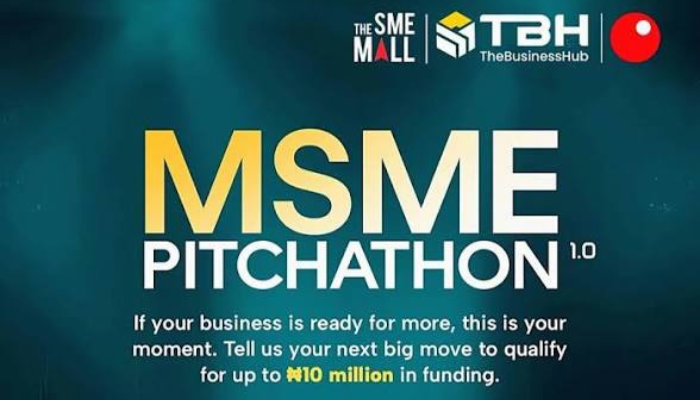
The Business Hub, known as TBH, has partnered with Sterling Bank to open applications for its MSME Pitchaton 1.0, a programme offering Nigerian businesses a hybrid funding package of up to N10 million. The money comes as a mix of grant funding and structured loans, with 12 months of business support and mentorship. The announcement was published on 3 November.
Read also: Minister says MSMEs make up 96% of Nigerian businesses, 87% of jobs
What is on offer
According to the programme website, selected businesses will receive a combination of grant funding and structured loans, along with digital tools, market access and banking support through Sterling Bank. Participants also get a year of mentorship and business development help. The website says more than 500 MSMEs have been empowered across six industries, a figure that comes from the organisers.
The reports do not say how the N10 million splits between grant and loan, what interest rate applies to the loan portion, or how many businesses will be funded. Those details decide the real value of the package.
Read also: DBN disburses N1.4 tn to Nigerian MSMEs, launches women’s initiative businesses
Who can apply
Applicants must run an active business in Nigeria or be willing to register one, and have a clear business model with room to grow. They need to show consistent transactions and revenue, require funding of up to N10 million, and hold an existing or newly opened Sterling Bank business account.
The Sterling account requirement matters. It gives the bank a view of a business’s cash flow and brings a new customer onto its books, which is a fair trade for many small firms but should be understood before applying.
How selection works
Businesses apply through the programme’s online portal, giving business details, submitting a pitch and stating how much funding they need. Shortlisted applicants pitch to a panel of industry experts and financial partners. Successful businesses move on to funding and onboarding, subject to the programme’s selection process and terms.
Read also: Cascador, Sterling Bank launch $200m SME Credit Backstop Fund
Reading the offer
Cost of borrowing is the main thing to check. The Manufacturers Association of Nigeria has said commercial bank lending rates averaged 32.1 per cent for very short-term loans. A loan portion priced near that level would absorb much of the benefit of the grant, so applicants should ask for the rate, tenor and repayment schedule in writing before accepting.
The structure also rewards businesses that can document themselves. Organisers ask for consistent transactions and revenue, which echoes what bank lenders say about bookkeeping. A trader who keeps clean records and uses a business account regularly is better placed than one who runs everything in cash.
A hybrid package is only as good as its grant share and loan price. Owners should compare it with other funding on offer. ProMoat Capital, for example, has opened a separate N1.5 million grant for two businesses, with no equity and no repayment, and applications close on 30 November.
What to watch
Sterling Bank has been active in the small business space, having signed a $30 million facility with Proparco on 29 October to finance solar projects and agricultural SMEs. A pitch programme is a smaller undertaking, but it feeds the same goal of bringing small firms into the bank’s lending pipeline. The test will be how many applicants win funding and how those businesses perform a year later.