

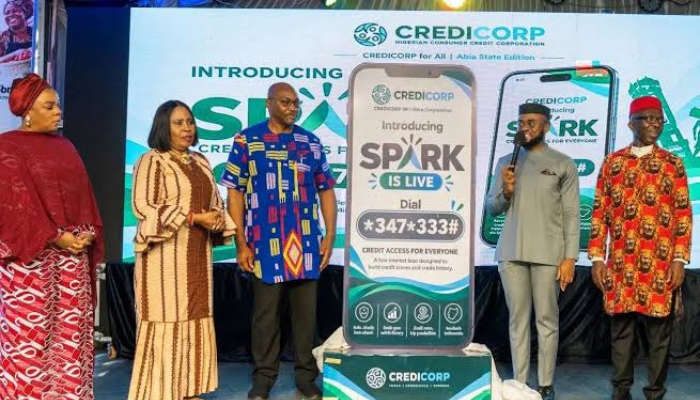
The Nigerian Consumer Credit Corporation, known as CREDICORP, has launched SPARK, a USSD-based credit product for Nigerians who have no smartphone or internet connection. It is aimed at small business owners, low-income earners and first-time borrowers, and lets them apply for credit from a basic phone while building a formal credit history. CREDICORP says SPARK should become more widely available before the end of 2026.
Read also:Nigeria’s fintech industry has technology gap nobody is talking about, SMEs are paying for it
How SPARK works
USSD is the technology behind the menu codes that many people use on feature phones to check balances or buy airtime. It works without mobile data or an app. A borrower dials a code and follows the prompts, which removes two barriers that keep many traders out of digital lending.
SPARK was unveiled on Wednesday at the CREDICORP for All showcase in Aba, Abia State. The event drew more than 1,000 market women, traders, young entrepreneurs and transport operators. Reports do not give loan sizes, interest rates, repayment periods or the lenders that will fund the product. Actual access will depend on eligibility, participating lenders and the final rollout.
Read also: GTCO third edition, Take on Squad Hackathon aim to drive digital solutions for businesses
Why a credit history matters
CREDICORP says borrowers who repay on time will gradually build credit profiles that can improve their access to other financing. For many traders, that is the real obstacle. Lenders cannot assess someone with no formal record, so they either refuse the application or ask for collateral the borrower does not have.
A small first loan, repaid on schedule, creates a record. How useful it is depends on whether that record reaches the credit bureaus and whether other lenders use it.
The track record so far
CREDICORP says it has facilitated more than ₦53.5 billion in consumer credit for over 351,000 Nigerians since it began operations, with women making up about 59 per cent of beneficiaries. That works out at roughly ₦152,000 per borrower. Loans of that size suit stock, tools and working capital, not large business expansion.
The showcase also featured the Securing Consumer Access for Local Enterprises initiative, known as S.C.A.L.E., which provides credit for locally assembled tricycles and links buyers to Nigerian manufacturers and vendors. Armstrong Ume Takang, chief executive of the Ministry of Finance Incorporated and a CREDICORP board member, said the model shows how government-backed financing can support local manufacturers and stimulate economic activity.
Read also: MoMo PSB, SMEDAN partnership targets digital transformation of Nigerian SMEs
What owners should ask
SPARK is a consumer credit product, not a business loan, even though traders are among its target users. Owners should find out the full cost of borrowing, the repayment schedule and whether repayments are reported to credit bureaus. Easy small loans can also lead to over-borrowing, particularly where income is irregular.
SPARK’s value will depend less on how easy it is to borrow than on whether repayments feed into records that other lenders actually use. If they do, a basic phone could become a first step into the formal credit system for people who have been left out of it. If they do not, it risks being another short-term loan with no lasting benefit for the borrower.