


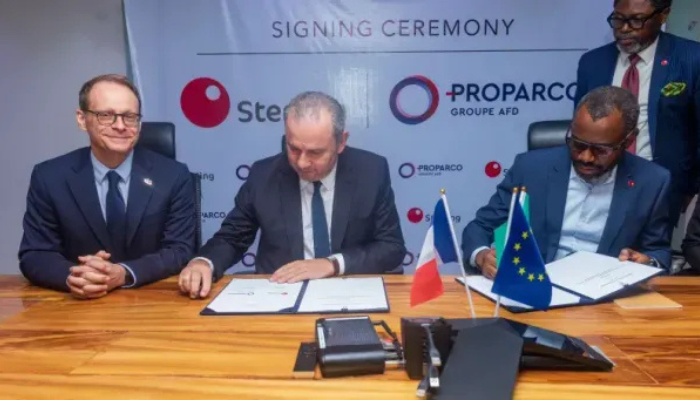
Sterling Bank has signed a $30 million senior credit facility with Proparco, the private sector financing arm of the Agence Française de Développement Group, to expand renewable energy financing and support small and medium-sized enterprises in Nigeria’s agricultural value chain. The deal was announced on 29 October. Abubakar Suleiman, the bank’s Managing Director and Chief Executive, and Christophe Lecourtier, chief executive of the French Development Agency, signed the agreement at Sterling’s head office in Lagos.
Read also: TBH, Sterling Bank open N10m funding window for MSMEs through pitchathon
How the money is split
Under the agreement, 80 per cent of the financing is earmarked for renewable energy, which comes to $24 million. The remaining 20 per cent, or $6 million, will go to SMEs in the agricultural sector. Most of the energy money is expected to support off-grid solar for households and businesses.
These are allocations within a credit line. They are not loans already given to Nigerian borrowers. Proparco lends to Sterling, and Sterling then decides which businesses and projects qualify.
Why solar and why now
More than a third of Nigeria’s population still lacks electricity, and the country had about 87 million people without power in 2024, the largest access deficit in the world. Suleiman said Nigeria has long treated its power problem as a generation problem waiting for the grid to solve it, when it is increasingly a financing problem with a distributed solution. Many households and businesses already spend heavily on generators but cannot raise the capital to switch to cleaner and potentially cheaper alternatives.
The facility fits Sterling’s HEART strategy, which prioritises health, education, agriculture, renewable energy and transport. The bank targets carbon neutrality by 2050 and has put solar on its headquarters and nearly half of its branches and ATMs. It also runs a renewable energy platform called Imperium and electric mobility programmes aimed at creating jobs for women.
Read also: Cascador, Sterling Bank launch $200m SME Credit Backstop Fund
What is still unknown
Sterling has not published interest rates, repayment periods, borrower eligibility or how currency risk will be handled. The last point matters. Proparco’s funds are in dollars, and a borrower paying in naira can be hit hard if the currency weakens. Those terms will decide whether the money makes solar cheaper for small businesses or simply adds to the bank’s lending capacity.
The facility is also modest beside other recent development finance lines. The African Development Bank approved $200 million for the Bank of Industry in May, and EIB Global and FCMB announced €85 million in October. As an illustration, $6 million in agricultural lending would fund 120 loans of $50,000 each, which is a small slice of the sector’s needs.
Read also: Learnstar opens N1.5m startup pitch challenge for Nigerian founders
What it means for businesses
For small firms that run on diesel or petrol generators, a dedicated solar credit line could mean lower fuel bills and more reliable operations. Equipment suppliers, installers and maintenance firms stand to gain as financing makes solar purchases easier.
The impact will hinge on how quickly Sterling deploys the funds and on the terms it offers. If loan terms are affordable and approvals are quick, the facility could help small businesses move off generators. If not, the money may reach only larger borrowers.