

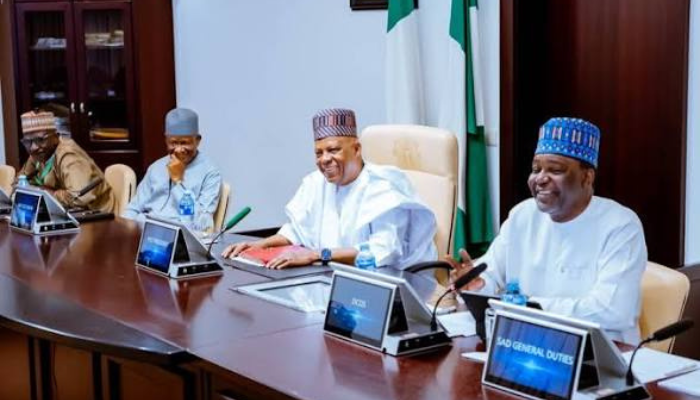
Vice President Kashim Shettima has directed the Federal Government to hold quarterly meetings with micro, small and medium-sized enterprises, so that business owners can contribute to policies that affect their operations. He gave the directive on Friday at an MSME stakeholders’ meeting at the Presidential Villa in Abuja.
What he ordered
Shettima told Temitola Adekunle-Johnson, the Special Adviser to the President on MSMEs and Job Creation, to expand the membership of the stakeholders’ forum and convene it every quarter. He also instructed that each meeting review the decisions taken at the previous one, so that officials account for progress before moving to new items.
The Vice President said small business owners must have a more decisive voice in government deliberations. He argued that even the smallest shop can carry the livelihood of an entire household, and he reaffirmed the administration’s commitment to improving small businesses’ access to finance.
Read also: TBH, Sterling Bank open N10m funding window for MSMEs through pitchathon
The N200bn fund
Shettima cited the Federal Government’s approval of ₦200 billion to support small businesses and manufacturers. The money is expected to improve access to capital, raise productive capacity and support job creation.
Last week, Minister of State for Industry John Owan Enoh described a N200 billion intervention fund in which N5 billion was set aside for MSMEs, which is 2.5 per cent of the total. If it is the same fund, most of the money is not aimed at micro and small firms. Enoh also said businesses without proper records and formal structures often struggle to meet the documentation requirements attached to such funds.
Read also: Minister says MSMEs make up 96% of Nigerian businesses, 87% of jobs
What stakeholders asked for
Adekunle-Johnson called for sustained collaboration between government institutions and the private sector to improve access to affordable financing, modern equipment and markets. Representatives of government agencies and business associations asked for more funding, training, capacity building and access to international markets. They said that addressing these gaps would help MSMEs expand, compete and create jobs.
Why the accountability clause matters
Consultations with small businesses are not new. In February 2025, the National Council on MSMEs met at the State House, set up a committee to work with the Central Bank on small business financing and approved a loan scheme for small firms. What is new is a fixed schedule and a requirement that each meeting report on the last.
That follow-up rule is the part with real teeth. Without it, forums tend to produce long lists of requests that are never tracked. With it, business owners can ask officials which decisions were carried out and which were not.
Read also: FG launches Tinubu Light Initiative to cut energy costs for one million Nigerian MSMEs
What to watch
The directive does not say who will join the expanded forum. For it to represent the sector, it needs trade associations, market unions, women-led and youth-led businesses, and operators outside Abuja and Lagos, not mainly large business groups. Owners will also want the resolutions of each meeting published, along with a timeline and the agency responsible for each action.
If the meetings are held and the follow-up is real, the forum could give small businesses a regular route to policymakers. If not, it will be another round of talks.